
Biking in Washington Park:
Where to Ride & How to Get Around
For cyclists who prefer to earn their views, Washington Park is one of Portland’s most rewarding climbs. The Park’s winding roads, steep grades, and mix of quiet forest and landmark vistas make for a memorable ride, whether you’re spinning up from downtown or linking it into a longer westside route.
We’ve rounded up everything you need to know about riding in Washington Park: which roads and entrances are open to bikes, where you can park, and how to navigate the Park’s shared roadways.
Riding Rules and Road Access
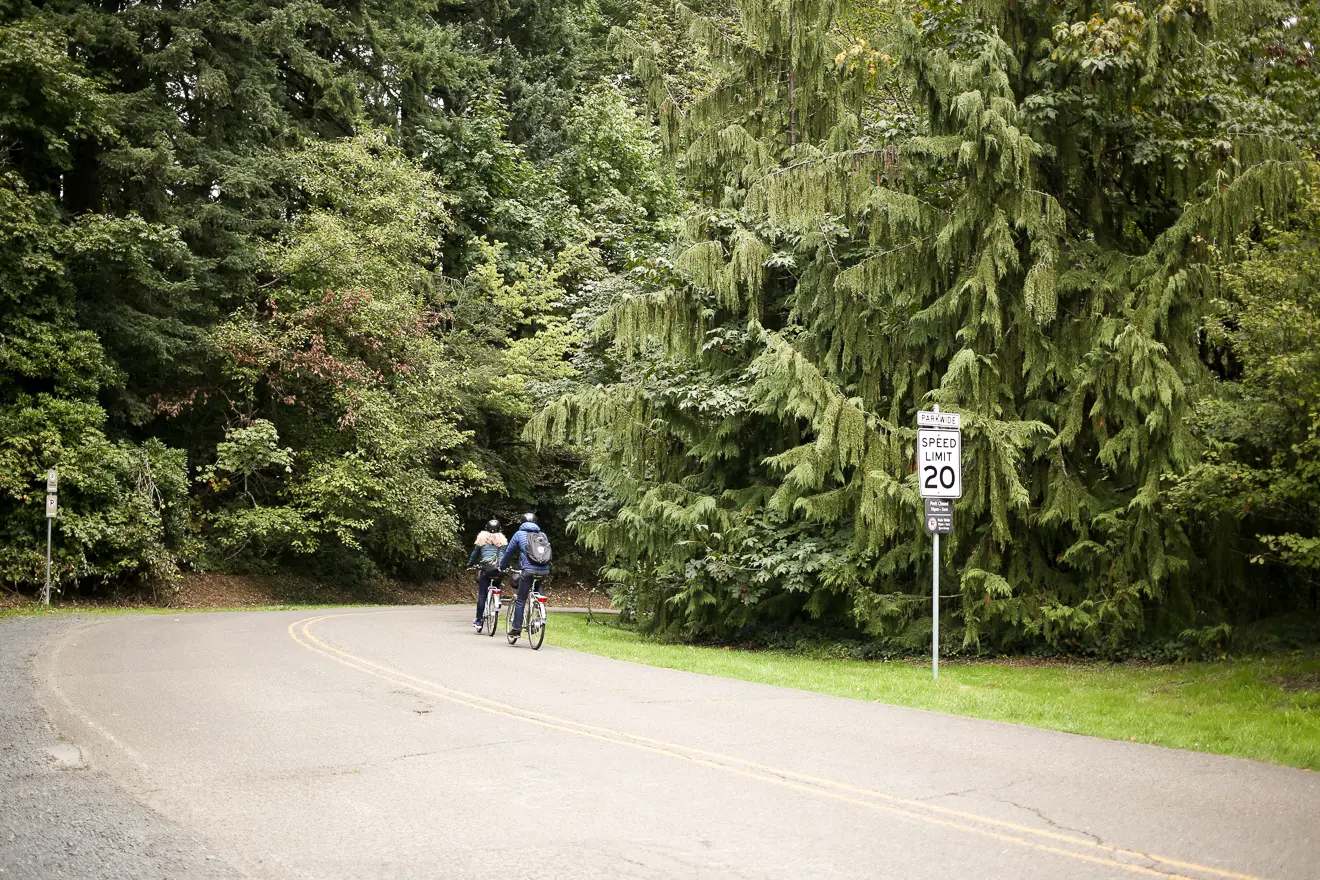
Washington Park’s 410 acres are threaded with paved roads and walking trails—but bikes belong on the roads only. Soft-surface and hiking trails are off-limits to all bicycles, including e-bikes.
Speed and flow
The Park-wide speed limit is 20 mph for all vehicles including bicycles. Be sure to take note and abide by the direction of one-way streets in Washington Park. Expect some tight turns and limited visibility, especially on the descent from SW Fairview Boulevard to the Rose Garden area.
Where you can ride
Bikes are permitted on all public roadways within the Park, including:
- SW Park Place to SW Lewis and Clark Way
- SW Kingston Drive
- SW Rose Garden Way (one way–uphill)
- SW Fairview Boulevard
- SW Knights Boulevard
- SW Fischer Lane
Some paved connectors—like Stearns Canyon Drive and the Madison Court Trail—allow bike travel but are shared with pedestrians. Trails such as Wildwood, Marquam, and the network through Hoyt Arboretum are pedestrian-only.

Sharing the road
Cyclists share all internal Park roadways with cars and the Free Shuttle. Expect low but steady traffic volumes, especially between the Oregon Zoo and Portland Japanese Garden. On descents, ride single-file and be prepared for shuttle stops and pedestrians crossing to attractions.
Getting Into the Park by Bike

Washington Park’s boundaries meet Portland’s street grid in a few key places, but not every entrance is open to bikes.
- SW Park Place (downtown): The most popular bike approach from the city center. Connects to SW Kingston Drive and the Rose Garden area.
- SW Fairview Boulevard (northwest): Great approach from the west hills or Skyline area.
- SW Knights Boulevard / Canyon Road (south): Vehicle entrance near the Oregon Zoo and MAX station; accessible but high-traffic. Part of this road has a bike lane and the rest is roadway.
- Stearns Canyon (north): Pedestrian and bicycle-only entrance—closed to motor vehicles, ideal for a quieter climb into the Park.
Approaching from downtown? The climb from SW Jefferson onto SW Park Place is short but steep—about 600 feet of gain in under two miles. Once you crest near the International Rose Test Garden, the rest of the Park rolls gently westward.
Bike Parking and Facilities
You’ll find bike racks near every major attraction in the Park. Most are standard U-racks located near entrances and visitor centers.
- International Rose Test Garden: Multiple racks near the main entrance plaza.
- Portland Japanese Garden: Bike parking located across from the entry gate along SW Kingston Ave.
- Oregon Zoo & World Forestry Center: Racks adjacent to each entrance and near the MAX station.
- Hoyt Arboretum: Racks at the visitor center and along SW Fairview Boulevard.
Download the Washington Park Map (PDF) for precise locations.
If you’re using BIKETOWN, there’s a station near the Rose Garden on SW Kingston Drive, perfect for a one-way ride followed by a shuttle back down.
Recommended Routes
- Washington Park Loop: A classic short loop for locals: enter via SW Park Place, climb past the Japanese Garden, and continue west to the Oregon Zoo before looping back on SW Knights Boulevard and SW Kingston. Roughly 3.5 miles, with about 500 feet of climbing.
- West Hills Connector: Link Washington Park to Forest Park or Council Crest for a longer training route. From SW Fairview Boulevard, you can connect north to SW Skyline or descend east toward Burnside to rejoin Portland’s bike grid.
- Scenic Descent: For a smoother ride back into the city, take the descent along SW Kingston Drive toward SW Sherwood Blvd. Watch your speed on the final switchbacks—there’s limited shoulder space and occasional pedestrian traffic.
Combining Transit + Bike
If you’d rather skip the climb, take the MAX Blue or Red Line to Washington Park Station, the deepest transit station in North America. From there, you can ride uphill through the Zoo area and connect to Fairview Boulevard or Knights Boulevard to access the rest of the Park.
Bike access is allowed on all MAX trains, and TriMet racks are available at both the Zoo and World Forestry Center.

You can also use the Washington Park Free Shuttle, which loops through the Park and stops at all of the major attractions, and accepts bikes on a limited basis (space-dependent).
Pro Tips for a Smooth Ride
- Early mornings are best if you want the roads to yourself. Traffic and pedestrians increase dramatically after 10 a.m.
- The Park’s steepest sections are near the Rose Garden and Japanese Garden—bring low gearing if you plan to loop multiple times.
- E-bikes are permitted on paved Park roads, but not on trails or soft-surface paths.
In winter, expect leaf litter, moisture, and occasional road closures after storms. Check the Construction & Closures page before you ride.
Plan Your Ride
Map out your route using Portland’s interactive bike map. For a satisfying climb, scenic loops, and unbeatable views of Mt. Hood, Washington Park delivers a uniquely Portland ride—right in the heart of the city.
Ready to roll?
Share your ride photos with #ExploreWashingtonPark and tag @explorewashingtonpark to let us know your favorite climb or descent.
Washington Park Insider
Be first to know about upcoming events, learn about closures or construction that may impact your next visit, and get insider tips for a magical, memorable, and fun day in Portland’s premier park. Subscribe >>